OpenJDK and Tomcat on SLES 16: A Fully Supported Enterprise Solution
Java applications are essential for many businesses, requiring a stable, secure, and well-maintained deployment platform. For years, SUSE has offered fully supported OpenJDK and Apache Tomcat stacks directly delivered and integrated within SUSE Linux Enterprise Server (SLES). With SLES 16, SUSE elevates this offering: customers deploying Java workloads benefit not only from full subscription support for the entire stack, but also from a pre-configured environment ready for immediate deployment on AWS’ marketplace.
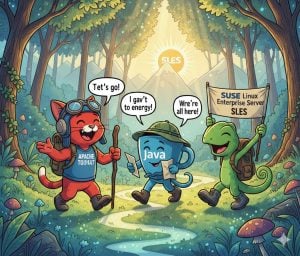
SLES Foundation and the Advantages of Integrated Components
SUSE Linux Enterprise Server 16 provides a secure and stable foundation. By packaging OpenJDK, which includes version OpenJDK 17 and the latest Long-Term Support (LTS) version OpenJDK 21, and Apache Tomcat, from version 9.x to the latest stable version 11.x, as supported modules within SLES, SUSE delivers a consistent, enterprise-grade environment.
The new integrated, pre-configured images offer several benefits for deployment and operations:
- Consistency and Predictability: The use of pre-configured images ensures that every deployment begins from a known, consistent state. This structure reduces configuration drift and minimizes environment-specific issues, leading to more reliable application deployments.
- Reduced Setup Time: The offering is designed to reduce the manual effort and time required to establish Java/Tomcat environments in the cloud. This streamlined approach supports rapid deployment of new applications.
- Security and Maintenance: The images adhere to SUSE’s certified Software Supply Chain Security and maintain a secure default configuration. Updates for SLES, OpenJDK, and Tomcat, including security patches and bug fixes, are provided regularly (quarterly) through the SLES maintenance model, facilitating reduced maintenance.
Apache Tomcat: Focus on Footprint and Reach
Apache Tomcat functions as a Web Container (implementing the Java Servlet and JSP specifications). It is widely used in production environments for hosting Java-based web applications. Tomcat’s utility in modern environments is based on its characteristics:
- Lower Resource Footprint: Tomcat typically has a smaller memory and disk footprint compared to a full Jakarta Enterprise Edition (JEE) application server.
- Scalability: The pre-configured images are designed to enable rapid and repeatable deployments of Java/Tomcat environments, allowing for efficient scaling of application infrastructure to meet fluctuating demands.
- Consistency and Availability: The image-based approach provides a reliable baseline, supporting quick recovery and consistency through the deployment of known good images.
Understanding the Scope: Tomcat vs. Full JEE
Tomcat is distinct from a full JEE Application Server, which includes a complete set of enterprise specifications (e.g., EJB, full JMS support). Tomcat provides the core Web Container functionality.
For applications that primarily use Servlets, JSPs, and standard Java APIs, Tomcat is a complete solution. For applications migrating from a full JEE server (like JBoss EAP) that relied heavily on EJB or other enterprise features, these features would need to be replaced by modern equivalents or external services when moving to Tomcat.
- Migration Path: Applications using common frameworks or relying only on the core specifications can often be migrated from full JEE servers to Tomcat with manageable effort.
- Fast Transition: For quick JEE app transition we join forces with our partners Oracle and Payara that provide JEE servers that run nicely on SLES.
Deployment Options and Cloud-Native Transition
SUSE provides clear paths for deployment and modernization:
- Package Installation: On any SLES instance, users can install Tomcat using the standard package manager, as both components are part of the SLES distribution. The component can be added using zypper install tomcat.
- Pre-configured Cloud Images: For cloud deployments, a pre-configured image, “Apache Tomcat on SUSE Linux Enterprise Server 16”, is available in the AWS Marketplace. This image is pre-configured for web application deployments, with the war files placed into /srv/tomcat/webapps, allowing an available application to run quickly.
- Modernizing Linux Workloads: For customers transitioning to Kubernetes, Tomcat is available as a container image within the SUSE Application Collection. This provides a straightforward path for moving existing Java workloads running on Linux into a modern containerized environment.
The integration of OpenJDK and Tomcat with SLES provides a supported, reliable platform for enterprise Java applications, simplifying adoption and deployment in cloud environments. Go try SLES 16 now, or even better, request an instance of Apache Tomcat on SUSE Linux Enterprise Server in AWS.
Related Articles
Oct 01st, 2024
How to enhance VM Security with AMD SEV-SNP on SLES 15-SP6