
Building the European Sovereign Stack: SUSE and evroc Join Forces for a Truly European Cloud
What makes a stack truly sovereign
European enterprises are rapidly recognizing that digital sovereignty is no longer a theoretical concept but a strategic requirement. The European Commission’s Cloud Sovereignty Framework clearly defines that sovereignty depends on three inseparable elements: jurisdictional control over infrastructure, autonomy in software choice, and independent operational support. Organizations across sectors are waking up to the reality that relying solely on one provider can limit their ability to comply with evolving European regulations and to maintain control over their data and workloads.
Today, SUSE and evroc announce a new partnership that directly answers this need. Both companies have deep European roots and a strong presence across the region. Together, they enable enterprises to run a complete open source infrastructure platform on fully European soil, with both infrastructure and support provided under European jurisdiction. This collaboration brings to life what digital sovereignty means in practice: trusted infrastructure from evroc combined with open, enterprise-grade software from SUSE giving customers freedom, transparency and continuity within Europe.
Key takeaways
- SUSE and evroc partnership: The collaboration creates a truly European Sovereign Stack, combining evroc’s infrastructure with SUSE’s open source software under European jurisdiction.
- Three pillars of sovereignty: This stack addresses the three inseparable elements of digital sovereignty: jurisdictional control, software autonomy and independent operational support.
- Compliance and security: The joint solution is designed to align with key European regulations, including the European Commission’s Cloud Sovereignty Framework, NIS2, CRA and DORA.
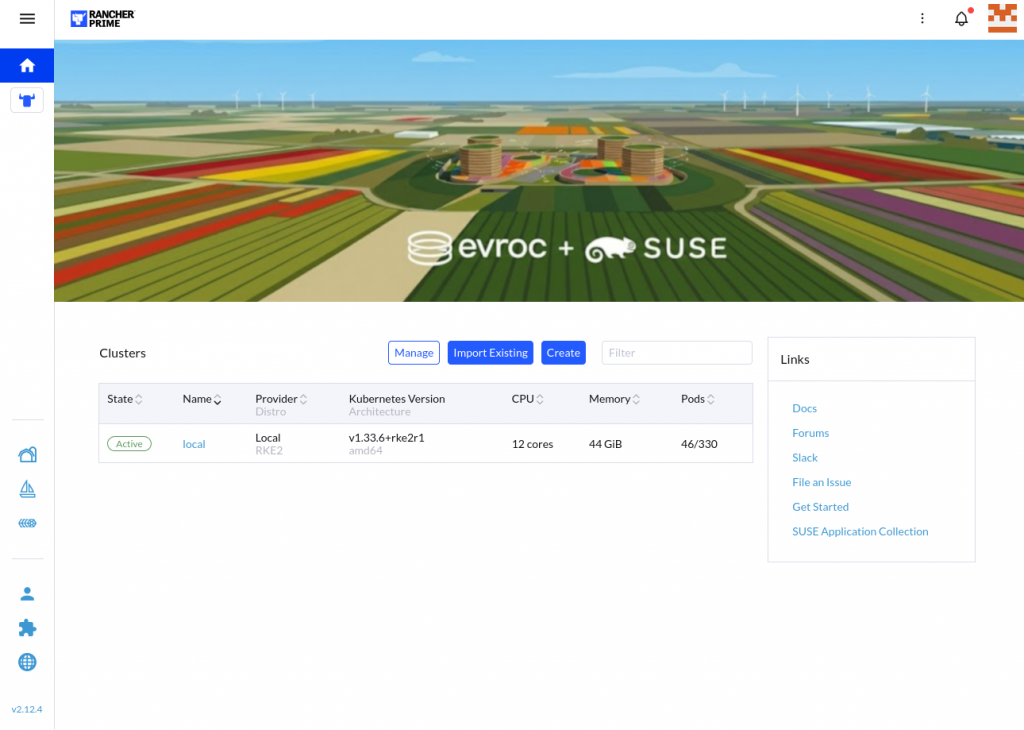
- Cloud native agility: The platform features SUSE Rancher Prime on evroc Cloud, enabling enterprises to manage hardened, compliant and portable Kubernetes clusters (RKE2) across multiple regions within Europe.
- Time-to-production: The deep technical integration simplifies cluster provisioning, allowing European enterprises to accelerate deployment while maintaining full governance and control.
Layer 1: Sovereign infrastructure
evroc forms the solid foundation of the European Sovereign Stack. Fully aligned with the European Commission’s Cloud Sovereignty Framework, evroc ensures that the infrastructure layer is free from any non‑EU geographical or jurisdictional influence. Its datacenters are based entirely within Europe, staffed and operated by European personnel, and designed to comply with regulatory frameworks such as NIS2, CRA, and DORA. Working closely with major European institutions, evroc provides scalable, high‑performance cloud environments and continues to expand its presence across the continent, including several wholly owned datacenters. This infrastructure guarantees that all workloads and data remain under European legal protection, an essential first step toward full digital independence.
Layer 2: Sovereign operating foundation
The operating layer sits between raw infrastructure and applications and having it right is crucial for enterprises running mission‑critical workloads. Imagine a major European bank operating tens of thousands of servers that process payments and maintain customer records 24/7. For such an institution, the operating system must deliver uninterrupted availability, certified support, and long‑term lifecycle stability. That’s why many such organisations choose SUSE Linux Enterprise Server (SLES) for their core server estate. One prominent example is Deutsche Bank, which after more than 20 years of partnership with SUSE expanded its Linux estate under SUSE’s enterprise‑grade support. At the same time, the container‑and‑edge era demands a lighter, more agile OS. That’s where SUSE Linux Micro (SL Micro) comes in with immutable root file system, atomic updates and optimised for cloud native workloads.
When you pair a truly European infrastructure provider with a software foundation from a vendor that has decades of enterprise experience, you get a combination that delivers both sovereignty and dependability. And because the foundation is SUSE’s platform, you instantly open up the full ecosystem of certified ISV partners and open source workflows. In other words, it isn’t just the OS; it’s the entire partner‑certified stack, ready to go, on infrastructure that is within Europe, supported by European teams, and designed for enterprise scale.
Layer 3: Sovereign orchestration
For any modern enterprise, orchestration is where sovereignty meets agility. In our earlier banking example, beyond maintaining secure operations, development teams increasingly need to build and deploy new digital services payment apps, analytics engines, and AI models on flexible, cloud native platforms. SUSE Rancher Prime, the enterprise edition of Rancher Manager, provides exactly that: full lifecycle Kubernetes management for clusters at scale, while keeping governance and compliance under European control.
Through this partnership, evroc’s European cloud platform directly integrates with SUSE Rancher Prime, allowing organisations to create, manage, and monitor Kubernetes clusters across multiple regions. At the core lies RKE2 (Rancher Kubernetes Engine 2), SUSE’s hardened, enterprise-grade Kubernetes distribution. RKE2 is designed for high security and compliance, offering CIS‑benchmarked configurations and FIPS‑validated cryptography. This means that even the most regulated environments such as those in finance can operate cloud native workloads with confidence.
The advantage of enabling RKE2 on evroc’s infrastructure is threefold:
1. Unlocking the full SUSE and RKE2 ecosystem – By running RKE2 on evroc, enterprises instantly gain access to the extensive ecosystem of certified integrations and open source tools built around Rancher and RKE2. Monitoring, GitOps pipelines, and policy enforcement through Kubewarden become available out of the box.
Business value: this drastically shortens time‑to‑production for development teams and ensures that critical controls and observability practices are enterprise‑ready from day one.
2. True workload portability – RKE2 clusters are fully open and independent from any hyperscaler‑specific Kubernetes flavour. Workloads deployed on evroc can be migrated to another environment or region without modification.
Business value: this protects long‑term freedom of choice, avoids lock‑in, and enables cost‑optimised scaling across multiple environments when business or compliance requirements change.
3. Enterprise‑grade security and sovereign support – RKE2 is a hardened, CIS‑benchmarked, FIPS‑validated Kubernetes distribution supported by SUSE Sovereign Premium Support.
Business value: banks and other regulated organisations benefit from a secure, compliant platform with all updates, incident response, and expertise delivered entirely within European jurisdiction.
Together, evroc and SUSE offer a sovereign orchestration platform that gives developers freedom to innovate while IT maintains full operational control bringing modern application delivery firmly into the European domain. I’ll leave it to James Collis at evroc to sum it up.
“evroc’s mission is to make European cloud infrastructure accessible and reliable for every enterprise. Together with SUSE, we’re not just providing servers and software, we’re building a foundation for Europe’s digital future.”
Related Articles
Aug 22nd, 2024
SUSE Linux Enterprise Micro 6.1 Public Beta is now available
