Supercharge the Telco Edge with SUSE and Ampere: The cloud-native fix for power-hungry infrastructure
The Edge Infrastructure Perfect Storm
Have you noticed the perfect storm brewing in the telecommunications world lately? With the massive push toward 5G-Advanced, Open RAN, and AI-driven automation, network traffic is absolutely exploding. But there is a huge roadblock: the physical edge locations where all this data needs to be processed are severely limited on space, power, and cooling.
Why Throwing Hardware at the Problem No Longer Works
Historically, the industry’s default fix has been to throw traditional, high-power x86 platforms at the problem and slap on discrete accelerators like FPGAs, SmartNICs, or GPUs to handle the heavy lifting. Unfortunately, this strategy is hitting a wall. Energy prices have jumped 50-100% in recent years, and these accelerator-heavy setups are routinely devouring 800 to 1200 watts per node. Add in the headaches of vendor lock-in and agonizingly slow integration cycles, and it is clear the old way just isn’t economically or environmentally sustainable anymore.
A Smarter, CPU-Based Powerhouse
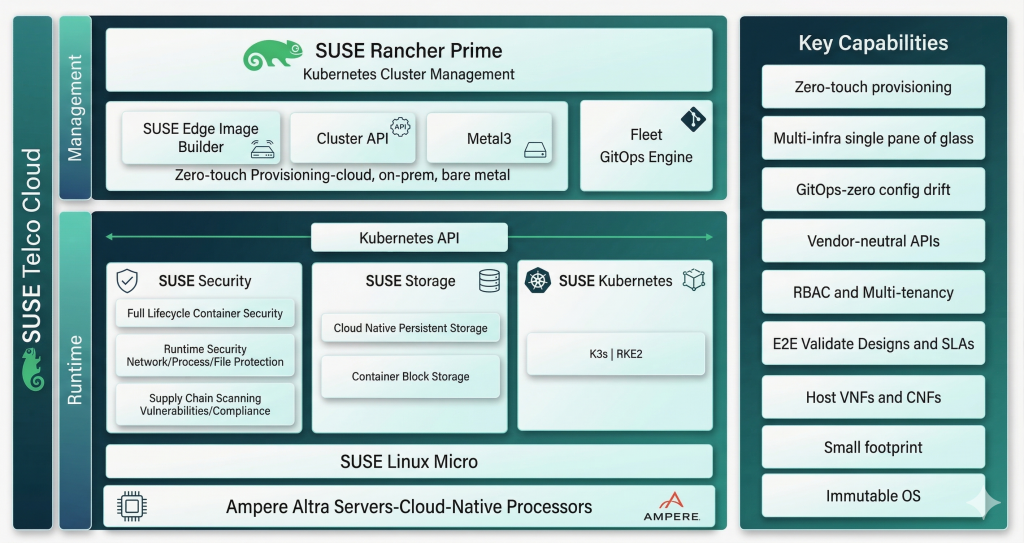
We knew there had to be a smarter path forward. That is why we partnered with Ampere Computing to build something entirely different, detailed in our new Technical Reference Documentation (TRD): SUSE Telco Cloud on Ampere Platforms. Instead of relying on a tangled web of specialized hardware, this new architecture is a cloud-native, entirely CPU-based powerhouse. It leverages Ampere’s incredible ARM-based processors, which pack up to 192 cores into a single socket.
What This Means for Your Network Operations
Here is what this means for your network operations:
- Do More with Less Power: You get phenomenal compute density, meaning you can squeeze way more performance into tight edge footprints while actually slashing your energy bills.
- Break Free from Lock-in: By ditching closed, accelerator-dependent designs, you gain ultimate freedom. You can seamlessly run any certified containerized or virtualized network function—whether it is an open-source L1 or a cutting-edge AI inference app—on the exact same horizontal node.
- Rock-Solid Predictability: 5G data cannot wait around. By combining Ampere’s uniform memory hierarchy with SUSE’s real-time OS tuning, you get the strict, deterministic performance necessary for heavy Layer 1 and Layer 2 packet processing, effectively eliminating “noisy neighbor” interference.
- Rollouts on Autopilot: Configuring thousands of remote edge sites is usually a nightmare. We show you how to use SUSE Edge Image Builder to create customized, immutable OS images that allow for true zero-touch provisioning—even if the site has a low-bandwidth connection or is completely air-gapped.
Time to Upgrade Your Edge Strategy
Whether you are a network architect mapping out the jump to 6G, or a platform engineer trying to wrangle infrastructure complexity and total cost of ownership, this guide is packed with the blueprints, BIOS tuning prerequisites, and performance data you need to succeed. Check out the full SUSE Telco Cloud on Ampere Platforms TRD today to see exactly how to bring incredible efficiency to your edge deployments!
Related Articles
May 16th, 2025
Is Cloud Native Telco the Future of Communication?
Dec 01st, 2025
Sovereign AI: Why Telcos Must Regain Control to Innovate