Powering Modern Virtualization with SUSE and NetApp
In the world of hybrid cloud infrastructure, the lines between traditional virtual machines (VMs) and modern containerized applications are blurring. Organizations today need a unified platform that can handle both without compromising on performance or reliability. At SUSE, we provide that cohesive experience through SUSE Virtualization, our cloud-native hyperconverged infrastructure (HCI) solution built on the power of Kubernetes.
However, even the most robust virtualization platform is only as good as the storage powering it. This reality is why I am thrilled to highlight our latest Technical Reference Documentation focused on the integration of SUSE Virtualization with NetApp Storage.
Bridging the gap for enterprise persistence
Moving to a cloud-native virtualization environment often brings up a critical question regarding how to ensure mission-critical VMs have the persistent, high-performance storage they require. While SUSE Virtualization provides integrated distributed storage, many of our enterprise customers rely on the proven capabilities of NetApp ONTAP for their data management.
The goal of this solution is to bridge these two worlds, allowing architects to manage, protect, and move data across hybrid environments with ease. By leveraging these technologies together, organizations can achieve a flexible, scalable, and resilient infrastructure platform for all workloads.
Dynamic storage orchestration with NetApp Trident
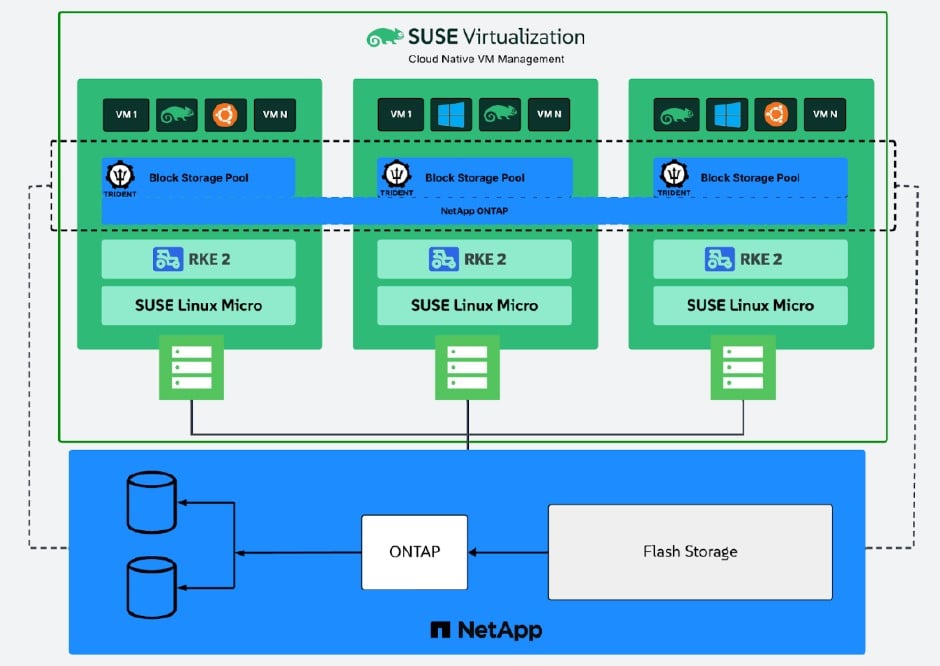
The “secret sauce” in this integration is NetApp Trident, an open-source storage orchestrator that serves as a Container Storage Interface (CSI). Trident allows SUSE Virtualization to dynamically provision and manage storage resources directly on NetApp ONTAP systems.
Key technical advantages of this integration include:
- High Availability through Multipathing: Configuring multipath support ensures that storage traffic can automatically fail over if a network path becomes unavailable, keeping workloads running without interruption.
- Dynamic Provisioning: Using Trident, administrators can create a StorageClass that automatically handles LUN provisioning on the NetApp back-end, which significantly simplifies the VM creation process.
- Unified Management: The platform allows for running legacy VM workloads and modern containers side-by-side on a single, resilient platform.
Practical Implementation in the field
This guide serves as a hands-on manual for platform engineers and systems administrators. It provides the exact CloudInit configurations needed to set up persistent iSCSI initiators and provides step-by-step instructions for deploying the Trident controller.
The documentation also includes detailed validation steps to ensure your VMs are correctly backed by the NetApp CSI and the ONTAP iSCSI back-end. This ensures that enterprises can build a consistent, automated, and production-ready virtualization environment.
Driving innovation through open collaboration
Collaborations like this are what make the SUSE ecosystem so vibrant. This work was made possible by the technical expertise of Gopala Krishnan A, Suresh S, and Terry Smith. Their contribution ensures that our partners and customers have a clear technical roadmap to modernize their infrastructure with confidence.
Ready to dive in? Visit our documentation portal, read the full technical reference and start your integration journey. At SUSE, we believe in the power of Choosing Open, and with partners like NetApp, the possibilities for your hybrid cloud are truly limitless.
Related Articles
Feb 04th, 2025
Get Ready for Partner Summit 2025