Modernizing the 5G Edge: AI-Native Performance with SUSE, Intel, and Supermicro

The telecommunications landscape is shifting beneath our feet. As operators race toward 5G-Advanced and O-RAN, they face a daunting challenge: how to deliver sub-millisecond latency and massive AI inferencing without exploding their power budgets or physical footprints. Traditional, “accelerator-heavy” designs often lead to vendor lock-in and high operational complexity.
Today, we are thrilled to announce a new Technical Reference Documentation (TRD) guide that solves this equation: SUSE Telco Cloud on Intel® Xeon® 6 SoC-based Supermicro Systems.
The Power of a Single-Box, CPU-Only Solution
This validated reference design proves that you no longer need a rack full of specialized hardware to run a high-performance telco edge. By combining the SUSE Telco Cloud stack with Supermicro’s IoT SuperServers and Intel® Xeon® 6 SoC processors, we’ve created an AI-ready, consolidated platform that replaces legacy BBUs, external L1 accelerators, and discrete AI appliances.
Key Performance Breakthroughs:
- Up to 2.4x increase in RAN capacity compared to previous generations.
- Up to 70% lower power consumption per site, dramatically improving performance-per-watt.
- Up to 3.2x gain in AI RAN inference performance per core, thanks to integrated Intel AMX.
- Deterministic Low Latency: Validation testing showed sub 5 µs latency even under 95% CPU load on isolated cores.
Carrier-Grade Software Meets Ruggedized Hardware
The solution is built on a foundation of open standards to ensure maximum flexibility and prevent vendor lock-in.
- SUSE Telco Cloud: A hardened, modular stack featuring SUSE Linux Micro and SUSE Rancher Prime. It enables zero-touch provisioning and GitOps-driven automation for thousands of sites.
- Supermicro IoT SuperServers: These compact, outdoor-rated systems (1U and 2U options) are engineered for the harshest edge environments. The 1U SYS-112D-42C-FN8P is already an official O-RAN Alliance hardware reference design.
- Intel Xeon 6 SoC: Features integrated Intel vRAN Boost, Intel QAT for line-rate cryptography, and E830 NIC for nanosecond-accurate timing.
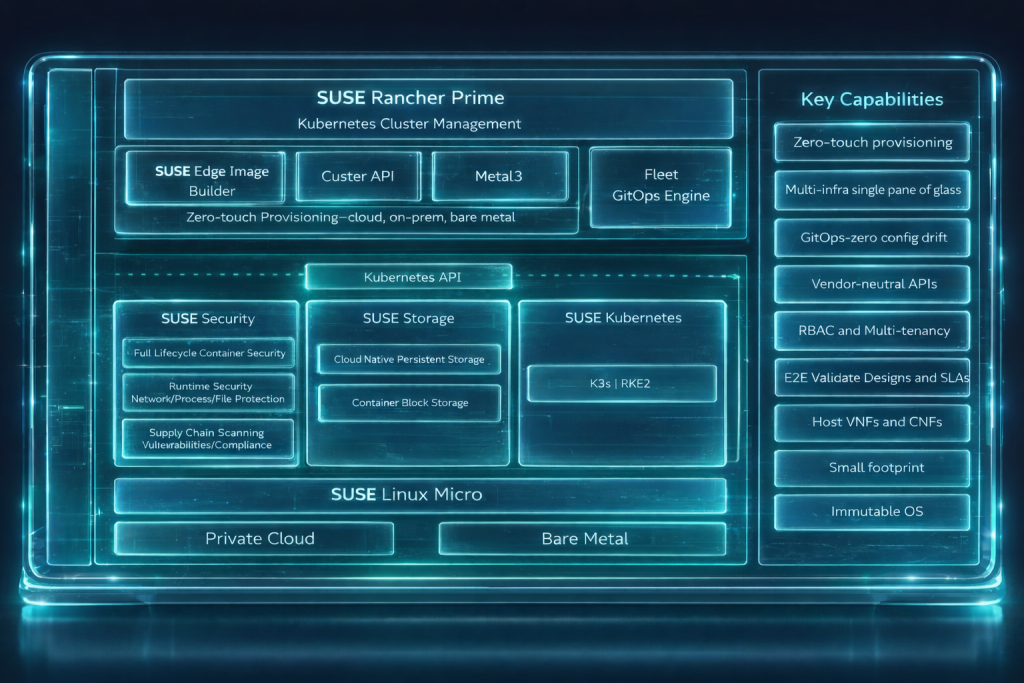
SUSE Telco Cloud Architecture
Why It Matters for Operators
Beyond the raw performance, this joint solution focuses on operational efficiency. By leveraging the Edge Image Builder (EIB), operators can create reproducible, auditable base images that facilitate true zero-touch provisioning even in air-gapped or low-bandwidth environments.
This is more than a speed boost; it is a blueprint for the AI-native 6G edge.
Ready to see the full architecture? Download the Technical Reference Design here to explore the deployment details, hardware configurations, and performance validation results.
Beyond this specific solution, you can find a wealth of architectural and design expertise by exploring our extensive library of Technical Reference Documentation (TRDs). These documents provide validated, step-by-step guides and proven reference configurations for a wide array of enterprise workloads and joint partner solutions, all designed to help you deploy with confidence.
Related Articles
Oct 01st, 2024
SUSE Documentation redefined — Meet the new doc portal