Driving 5G-Advanced and Open RAN Excellence: SUSE Telco Cloud on AMD EPYC 9005 Series Processors
Telecom operators face intensifying demands from 5G-Advanced and Open RAN, ranging from strict low-latency requirements to the operational complexity of integrating AI at the edge. The combination of SUSE Telco Cloud and 5th Gen AMD EPYC 9005 Series processors (code-named Turin) provides a robust, CPU-centric foundation designed to address these challenges.
By leveraging high core density, memory efficiency, and granular resource tuning, this architecture enables seamless workload consolidation for vRAN, 5G Core, and AI-augmented functions. This reference architecture delivers the deterministic performance, power efficiency, and operational simplicity required to scale intelligently while reducing network complexity.
Telco Market Challenges and Requirements
The rapid evolution toward 5G-Advanced and the large-scale deployment of Open RAN (O-RAN) have placed unprecedented computational demands on telecommunications infrastructure. Operators are moving away from traditional, hardware-centric designs toward fully software-defined architectures that must deliver significantly higher performance while operating under real-world constraints. This transition brings increased expectations around scalability, flexibility, and intelligence, but it also surfaces several critical technical challenges that general-purpose infrastructure must now overcome:
- Stricter Latency and Jitter Limits: The move to O-RAN and Ultra-Reliable Low-Latency Communications (URLLC) has introduced much stricter requirements for latency and jitter, particularly within the O-RAN fronthaul and midhaul interfaces. Engineering teams must achieve the same level of deterministic precision and timing accuracy on general-purpose CPU architectures that was previously exclusive to specialized Application-Specific Integrated Circuits (ASICs).
- Physical Edge Constraints with Power Efficiency: Expanding compute capacity at edge sites introduces severe physical bottlenecks, including restricted rack space, tight thermal envelopes, and limited power availability. Maximizing performance-per-watt and throughput-per-rack-unit is essential to scaling capacity without increasing physical footprints.
- AI Integration at the Edge: Embedding AI directly into the network fabric, for real-time beamforming optimization, traffic steering, and automated fault detection, adds massive computational intensity. These advanced workloads require a combination of high core counts, wide memory bandwidth, and efficient data movement to ensure deterministic execution during complex inference tasks.
- Operational Complexity and Vendor Lock-In: Reliance on specialized appliances, external accelerators, and proprietary platforms inflates CAPEX and lifecycle overhead, lengthens validation cycles, and complicates multi-vendor interoperability. Operators must modernize at speed while reducing cost, power, complexity, and risk simultaneously.
To address these needs, this reference architecture presents a validated integration of SUSE Telco Cloud on AMD EPYC 9005 Series processors (code-named Turin). This software-defined blueprint combines the high core density and memory throughput of the AMD Turin architecture with SUSE’s robust cloud-native management. The result is a future-proof, x86-based foundation for vRAN, 5G Core, and AI-augmented network functions, providing the deterministic performance and extreme density required for next-generation intelligent networks.
The Solution
Hardware Architecture: 5th Gen AMD EPYC Processors
The 5th Generation AMD EPYC processors bring a modular chiplet design built around Zen 5 cores.
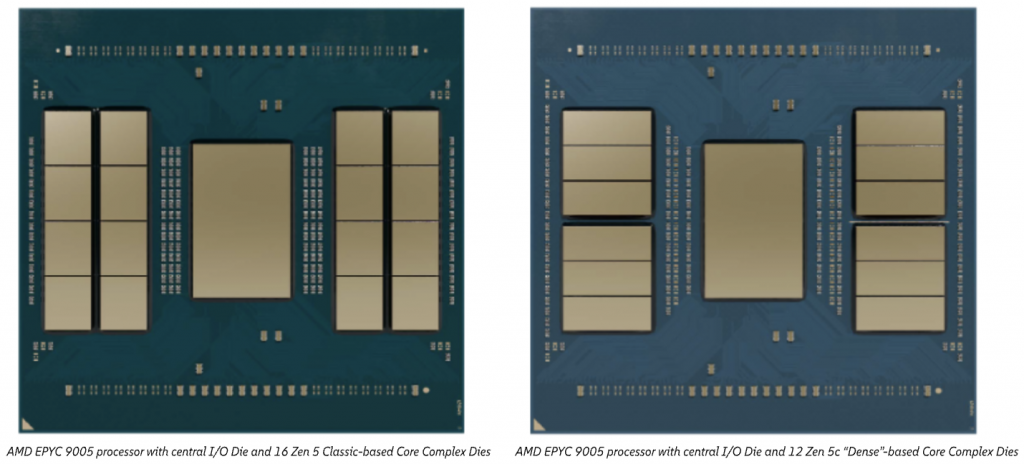
Each Core Complex (CCX) groups up to eight Zen 5 cores that share a 32 MB L3 cache, delivering fast data access for threads working closely together.
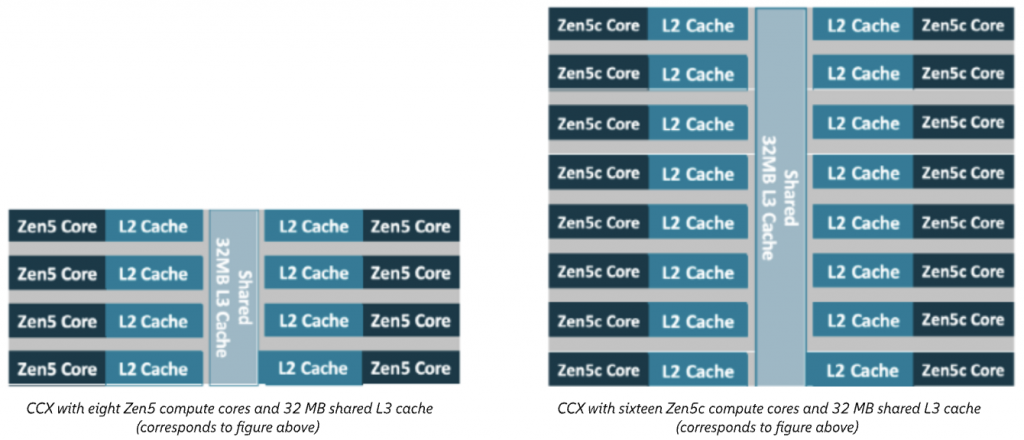
These CCXs reside on Core Complex Dies (CCDs), which connect through a central I/O Die using AMD Infinity Fabric. This architecture provides high core counts, substantial memory bandwidth via multiple DDR5 channels, and highly configurable Non-Uniform Memory Access (NUMA) topologies that telco operators can tune precisely to their workloads.
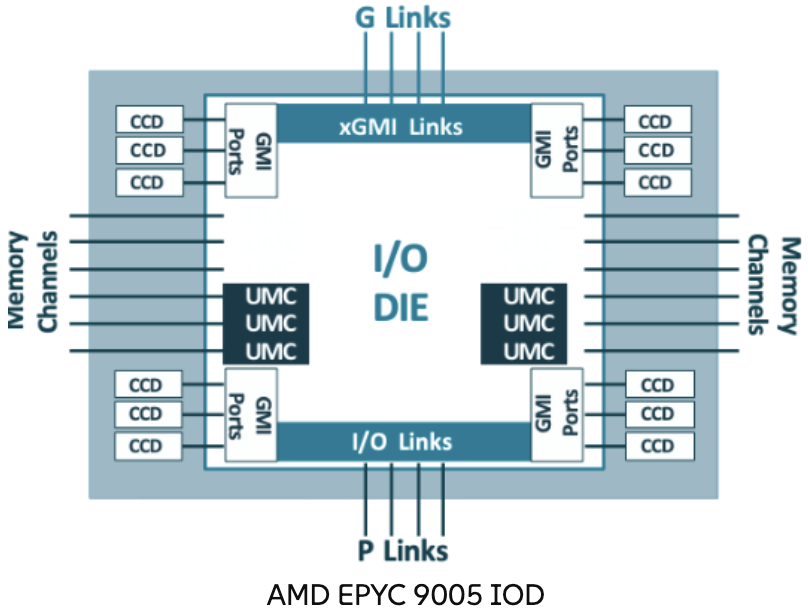
In dual-socket configurations, the platform delivers massive parallelism (up to 128 cores) while offering generous PCIe Gen5 lanes for high-speed networking cards and accelerators when needed. The design balances raw throughput with the predictable, low-jitter behavior essential for real-time telco applications. Features such as flexible NUMA Nodes Per Socket (NPS) settings and the option to treat individual L3 caches as NUMA domains give infrastructure teams fine-grained control over resource locality, memory interleaving, and thread pinning. This helps minimize cross-NUMA traffic that can introduce unwanted latency variation in packet processing or timing-critical functions.
For telco operators, these capabilities translate into better workload consolidation, improved power efficiency per core, and the ability to run both high-throughput data plane tasks and latency-sensitive control plane operations on the same general-purpose hardware. The architecture supports the industry shift toward CPU-centric designs that reduce dependency on specialized accelerators while still meeting strict performance service level objectives.
Software Architecture: SUSE Telco Cloud
SUSE Telco Cloud builds on SUSE Linux Micro, a lightweight, immutable operating system designed for edge and telco environments. It incorporates hardened real-time kernel capabilities, comprehensive automation for day-1 and day-2 operations, and full support for both virtual network functions (VNFs) and cloud-native network functions (CNFs). The platform integrates tightly with SUSE Rancher Prime for container orchestration and management, enabling GitOps-driven deployments that improve consistency and reduce human error across distributed sites.
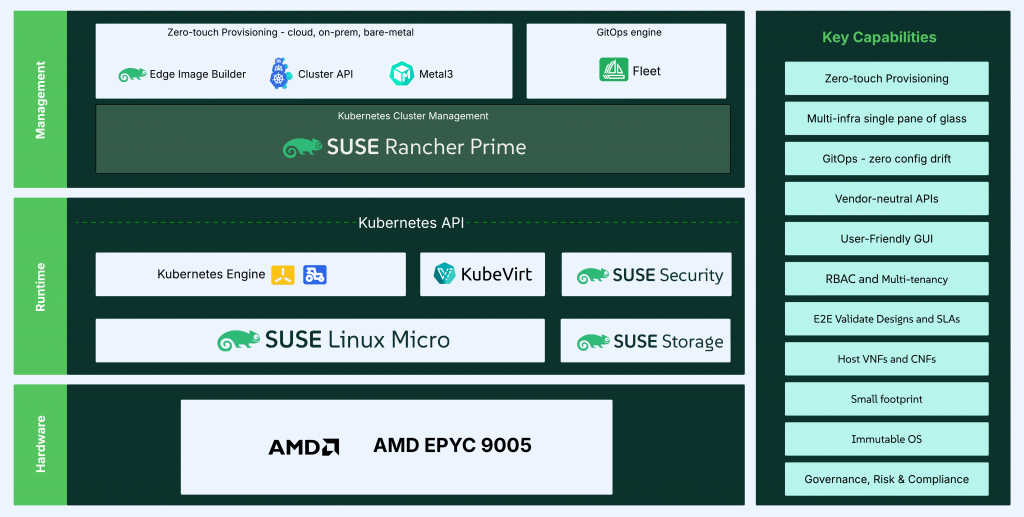
Key telco-focused features include advanced observability tools, security hardening aligned with industry standards, and automated lifecycle management that simplifies patching and upgrades without disrupting live services. SUSE Telco Cloud also provides optimized networking stacks with DPDK support, SR-IOV capabilities, and precise CPU isolation mechanisms that work hand-in-hand with the underlying hardware’s NUMA and cache architecture.
Together, the stack lets telco operators run consolidated workloads on general-purpose hardware while maintaining the isolation, determinism, and performance guarantees traditionally associated with specialized appliances. This carrier-grade foundation helps service providers accelerate innovation, lower total cost of ownership, and build infrastructure that can evolve smoothly toward 6G and greater AI integration in the network.
Deployment and Tuning for Deterministic Low Latency
The Validation and performance testing focused heavily on ensuring real-time consistency using cyclictest under heavy execution load. During evaluation, a rigorous set of low-latency best practices were applied to the platform:
SUSE Telco Cloud on AMD EPYC 9005 Series Processors
- Core and Thread Topology: Simultaneous Multithreading (SMT) was disabled, and housekeeping operating system cores were isolated exclusively to the first CCX (cores 0–7).
- Kernel Optimization: A real-time kernel was deployed utilizing standard isolcpus, nohz_full, and rcu_nocbs boot parameters.
- NUMA Configuration: Testing ran explicitly without forcing numa=off, allowing the underlying hardware NUMA capabilities to operate optimally.
A primary area of exploration involved testing the various NUMA Nodes Per Socket (NPS) BIOS configurations to evaluate workload behavior across different granularities:
| NPS Setting | Configuration Profile | Ideal Workload Target |
| NPS4 | Four NUMA domains per socket. | Provides the tightest hardware locality between cores, memory, and local I/O adapters. |
| NPS2 | Two NUMA domains per socket. | Offers a balanced domain split ideal for many common virtual network functions. |
| NPS1 | Single NUMA node per socket. | Enables full memory interleaving across the entire socket channel space. |
| NPS0 | System-wide single NUMA domain (Dual-socket only). | Simplifies resource allocation for less NUMA-aware workloads. |
Validation Performance Note: Across all tested configurations, the platform demonstrated strong, deterministic real-time behavior. Maximum latencies consistently remained in the low teens to upper single-digit microseconds under representative network traffic loads.
Practical Benefits for Telco Operators and Looking Ahead
This combination supports the shift toward CPU-only architectures. By removing reliance on discrete accelerators for many use cases, operators can simplify supply chains, reduce validation cycles, and lower both CAPEX and OPEX. The high core density and memory subsystem efficiency help maximize workload consolidation per site while keeping power and cooling demands manageable. The platform also aligns well with AI-native telco roadmaps. Strong per-core performance and cache hierarchies support both traditional packet processing and emerging inference tasks running alongside RAN or core functions.
The successful validation of SUSE Telco Cloud on AMD EPYC 9005 Series processors gives telco operators another proven path for building efficient, future-ready networks. Whether the priority is maximum density at the edge, deterministic performance for Open RAN, or a balanced platform ready for AI services, the joint solution offers the configurability and performance needed. The telecommunications sector is changing rapidly. Platforms that combine raw processing capability with operational simplicity and open standards will separate industry leaders from the rest. SUSE and AMD deliver precisely that foundation.
If you are currently evaluating next-generation telecom infrastructure, reach out to the SUSE and AMD account teams to initiate a technical proof of concept tailored to your specific deployment environment.
Related Articles
Mar 21st, 2025
What Is Root Cause Analysis (RCA) and Why Do You Need It?