Density, performance & TCO gains for telecom operators: SUSE Telco Cloud on Ampere® Platforms
Guest blog post authored by:
Sean Varley, Chief Evangelist and VP of Business Development at Ampere Computing
The Structural Transformation of the Telecommunications Landscape
Telecommunications operators are undergoing the most profound transformation in the history of the industry. The simultaneous rollout of 5G-Advanced, Open RAN, massive Multi-access Edge Computing (MEC), and the integration of AI-driven automation are driving exponential growth in traffic, processing requirements, and service-level expectations. The demand for agility, scalability, and cost-efficiency is pushing the industry toward cloud-native software stacks running on high-performance, energy-efficient, general-purpose processors. The convergence of high-performance hardware and optimized software stacks is crucial for success in the modern telecommunications industry.
The strategic collaboration between SUSE and Ampere Computing addresses these challenges by validating SUSE Telco Cloud configurations on Ampere® platforms. Our partnership represents a milestone in providing telecommunications operators with a horizontally scalable, vendor-neutral infrastructure that minimizes TCO while maximizing compute density in space-constrained edge environments. The move toward disaggregated, multi-vendor ecosystems requires a consistent underlying platform that can handle the deterministic latency and high-throughput requirements of modern 5G networks. For the deep-dive technical reference and deployment details, please visit the SUSE Documentation portal here.
Operational Constraints and the Radio Access Network (RAN)
Telecom operators face significant challenges when deploying RAN workloads, which require a combination of performance, latency, and power efficiency. The increasing demand for high-bandwidth 5G services has led to a surge in RAN traffic, making it essential to pack more compute resources into smaller footprints while optimizing power consumption. These workloads are no longer purely traditional packet-forwarding tasks. Modern Distributed Units (DU), Central Units (CU), User Plane Functions (UPF), and near-RT RIC platforms now embed significant machine-learning inference for beam management, load prediction, slice assurance, and security analytics. The net result is a dramatic increase in required FLOPS per site, yet most current deployments still achieve this through power-hungry discrete accelerators (FPGAs, SmartNICs, and GPUs) that add cost, thermal complexity, and supply-chain fragility.
Energy efficiency has become a hard operational constraint. Many edge sites are limited on power and cooling, while electricity prices in many regions have risen 50-100% in the last three years. Sustainability commitments further amplify the pressure where operators must materially reduce Scope 2 emissions while scaling capacity by orders of magnitude. Traditional high-TDP x86 platforms, even when paired with inline accelerators, routinely exceed 800-1200W per node under real-world vRAN loads – a trajectory that is no longer economically or environmentally viable at scale.
At the same time, the industry’s move toward disaggregated, multi-vendor ecosystems exposes the limitations of closed, accelerator-dependent designs. Long integration cycles, firmware inter-dependencies, and single-source inline cards slow down lab validation and field upgrades, while creating hidden TCO penalties that often exceed the original hardware savings.
Architectural Design for Cloud-Native Telco
The joint reference architecture from SUSE and Ampere Computing addresses these challenges with a radically simplified, high-efficiency, CPU-only platform built on Arm-based architecture silicon.
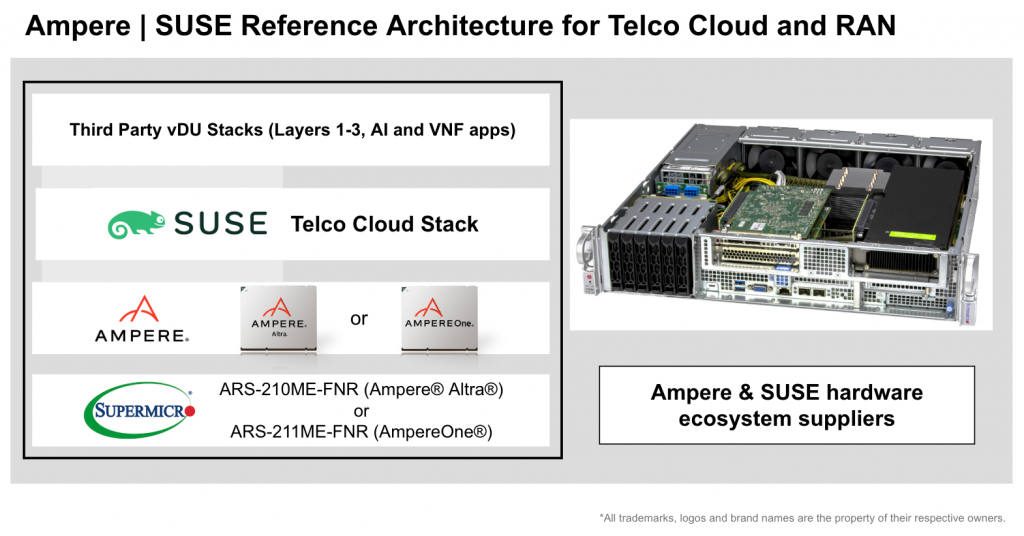
Ampere processors are built for high performance while delivering excellent power efficiency. In addition, the processors scale linearly with load thereby enhancing power efficiency for workloads that do not require the full core capacity of these high core count products. This characteristic also creates natural headroom for new applications or AI algorithms to expand functionality easily in power and space constrained environments like the Telco RAN. Finally, Ampere processors are highly predictable yielding very deterministic performance for parallel scale-out workloads like packet processing, SW-only L1 processing, L2/L3 stacks and the sensitive AI functionality many carriers want to deploy in their networks.
Ampere processors deliver up to 192 arm64 cores in a single socket with a completely uniform memory hierarchy and no performance variability across cores. Combined with the SUSE near RT OS for Telcos, this reference architecture addresses noisy-neighbor effects and provides the deterministic instruction retirement required for DPDK-based Layer 1 and Layer 2 processing in vRAN workloads.
Utilizing the Ampere platform’s unparalleled advantages in terms of core density and power efficiency, this solution is designed to pack more compute resources into smaller footprints while minimizing power consumption. This makes it an ideal fit for RAN deployments where space constraints are a significant challenge. The support of Arm-based hardware is a core pillar of SUSE’s Telco strategy due to the undeniable advantages in terms of core density and power efficiency.
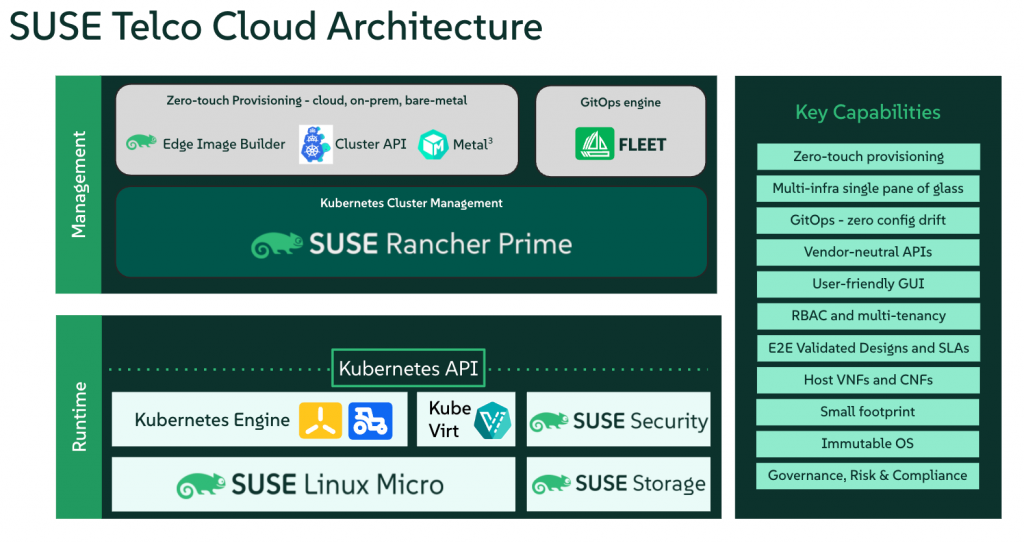
The SUSE Telco Cloud solution is specifically designed to take advantage of these benefits by providing a cloud-native infrastructure that is optimized for RAN workloads. Our combined solution includes support for containerization, microservices orchestration, and network function virtualization (NFV) – all essential components for deploying modern 5G networks. By using SUSE Telco Cloud on the Ampere Altra platform, telecom operators can enjoy a significant reduction in total cost of ownership while achieving better performance density, latency, and power efficiency.
Because the entire solution is purely CPU-based and fully open, operators avoid accelerator lock-in, reduce validation time from months to weeks, and can run any certified CNF or VNF on the same physical node, whether it’s a FlexRAN-style DU, an open-source L1, a 5G Core UPF, or an edge AI inference application. The result is a horizontally scalable platform that simultaneously maximizes site capacity, minimizes power and cooling requirements, and future-proofs the infrastructure for 6G-era workloads that will demand even greater compute density at the edge.
Conclusion and Next Steps
The Ampere and SUSE joint solution for telco clouds delivers a future-proof, open, cloud-native telco platform that combines unmatched core density, best-in-class power efficiency, and carrier-grade real-time performance, all without the need of additional accelerators or vendor lock-in.
Operators can now deploy high-capacity 5G RAN and edge services at dramatically lower power, space, and total cost while preserving full flexibility to run any CNF or VNF on the same infrastructure.
Next Steps:
- Explore the SUSE Telco Cloud documentation
- Schedule a joint proof-of-concept or sizing workshop with your SUSE and Ampere Computing account teams
- Meet with the SUSE and Ampere Computing teams in person at Mobile World Congress 2026 in March!
Guest author:
 Sean Varley is the Chief Evangelist and leader of ecosystem development and partner programs at Ampere Computing. His group is responsible for go-to-market, messaging, strategy and execution of developer, partner and revenue ecosystem growth programs. The team covers marketing strategy, strategic business relationships, business planning and developer recruitment for AI Computing in the rapidly evolving Cloud and Edge server markets.
Related Articles
Jul 03rd, 2024
CentOS 7 Extended Support: Stay Secure Post-EOL
Aug 13th, 2024
Gain experience in monitoring your SAP environment