Building the AI-Native Telco: SUSE Telco Cloud on Intel® Xeon® 6 SoC-based Supermicro systems
Guest blog post authored by:
Michael Holzerland, EMEA Telco Lead at Supermicro
Niall Power, Solutions Architect and Intel FlexRAN Software PLM at Intel
Telecommunications operators are transforming their networks to support 5G-Advanced, ORAN, massive MEC scale-out, and AI-driven automation. These transformations demand infrastructure that simultaneously delivers extreme packet-processing performance, deterministic low latency, integrated AI acceleration, and dramatically lower power and space footprints.
This article documents the successful validation of the SUSE Telco Cloud stack, built on SUSE Linux Micro and SUSE Rancher Prime, running on Supermicro systems powered by Intel® Xeon® 6 SoC processors, proving that a single-socket, CPU-only platform can replace legacy accelerator-heavy designs. For the deep-dive technical reference and deployment details, please visit the SUSE Documentation portal here.
The Market Challenge
Telecommunications operators today face an unprecedented convergence of pressures that legacy infrastructure was never designed to handle. Traffic volumes are exploding, driven by nationwide 5G rollout, massive IoT deployments, ultra-high-definition video streaming, private 5G networks, and enterprise edge services. At the same time, service-level agreements have become far more stringent with sub-millisecond end-to-end latency and microsecond-level jitter now mandatory for ORAN fronthaul/midhaul transport, Ultra-Reliable Low-Latency Communication (URLLC), industrial automation, and Extended Reality (XR) applications.
Compounding this is the rapid integration of artificial intelligence into every layer of the network. Modern RAN and core functions increasingly rely on embedded machine-learning models for dynamic beamforming, traffic prediction, interference management, anomaly detection, and closed-loop automation through RIC platforms. These AI-driven capabilities demand significant inferencing throughput directly at the edge, yet most existing deployments still depend on fixed-function RAN infrastructure defined before the AI boom.
Power consumption, cooling capacity, and physical space have emerged as hard limits at thousands of edge and far-edge sites. Rising energy prices and sustainability mandates are pushing OPEX ever higher, while the continued reliance on specialized appliances, external accelerators, and vendor-locked platforms dramatically inflates both CAPEX and lifecycle management overhead. Validation cycles lengthen, software updates become risky, and multi-vendor interoperability remains a constant friction point.
At the same time, regulators and enterprises are imposing stricter requirements for data sovereignty, hardware-rooted confidential computing, and verifiable platform integrity. Operators must modernize at speed while simultaneously reducing cost, power, complexity, and risk – an equation that traditional architectures can no longer solve.
The Solution
The combination of Intel® Xeon® 6 SoC based telco-optimized systems by Supermicro and the SUSE Telco Cloud stack directly addresses every dimension of these challenges with a single, fully integrated platform that is ready for massive scale-out today.
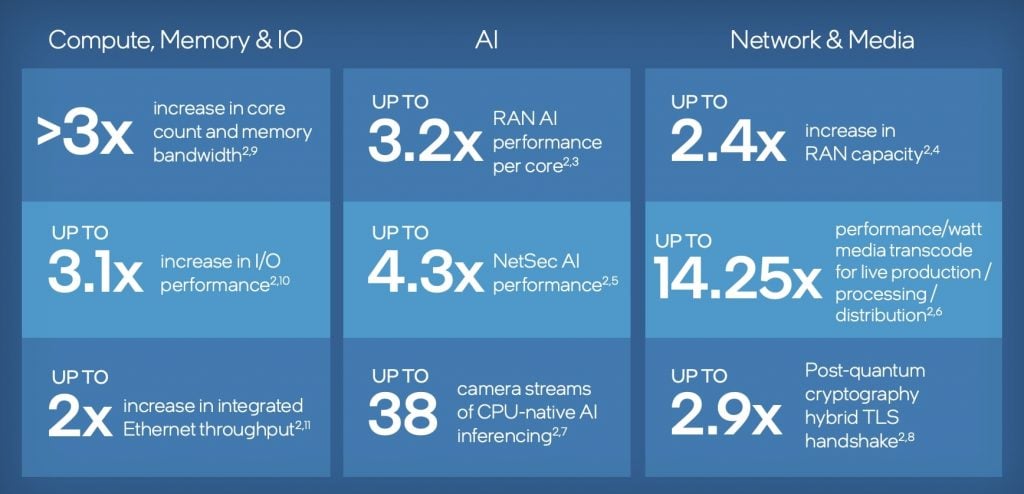
At the foundation sits the Intel® Xeon® 6 SoC, a purpose-built processor family that delivers up to 72 Performance-cores, enormous per-core caches for deterministic packet processing, and fully integrated Intel® vRAN Boost. Native Intel® AMX matrix extensions provide massive AI inferencing throughput without external accelerators, while on-die Intel® QAT handles compression and cryptography at line rate. With up to 128 PCIe Gen5 lanes and CXL 2.0 readiness, the platform offers unmatched I/O flexibility and future-proof expansion.
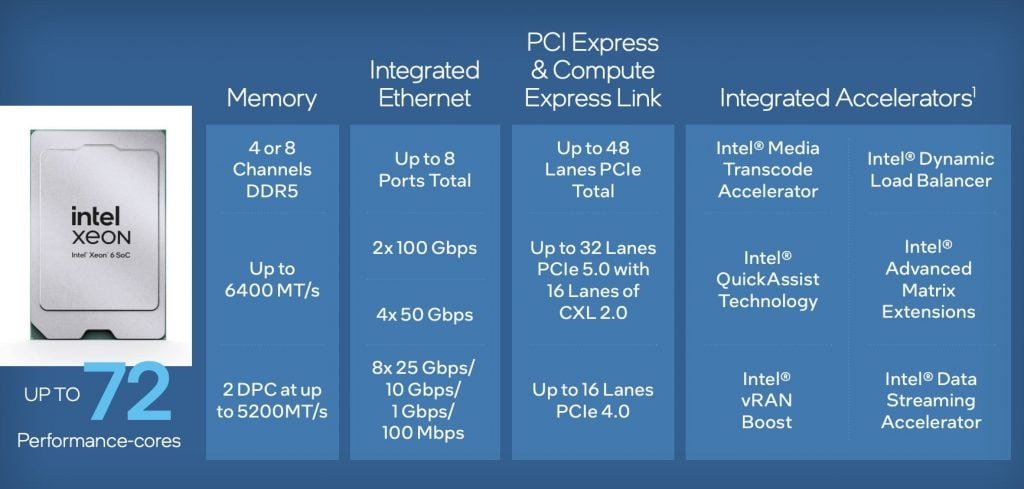
The Intel® Xeon® 6 SoC provides outstanding energy-efficient performance across networking use cases, including vRAN deployments. The platform’s P-cores are optimized for high throughput and low latency, with built-in acceleration for packet and signal processing, load balancing and AI. Building on that foundation, Intel vRAN Boost integrates vRAN acceleration directly into the SoC. Using the O-RAN Acceleration Abstraction Layer standardized DPDK interface, independent software vendors and software developers can easily optimize their vRAN software stacks for vRAN Boost hardware acceleration. The standardized interface makes it easier to move from one generation of Intel vRAN Boost to the next. Intel vRAN Boost is sized to ensure ample headroom even in the most intense use-cases and with the highest core count options, allowing future software optimizations to further increase server capacity without worrying about hitting acceleration limits.
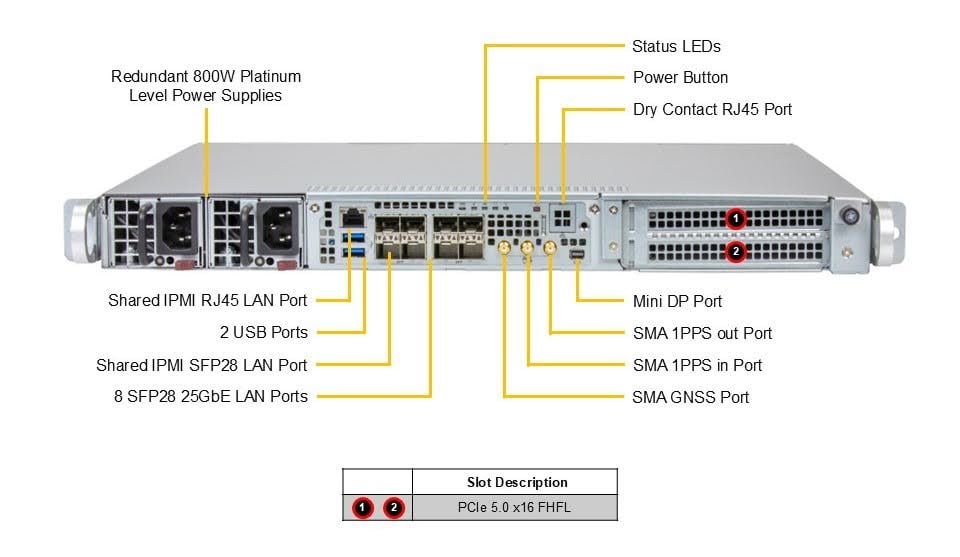
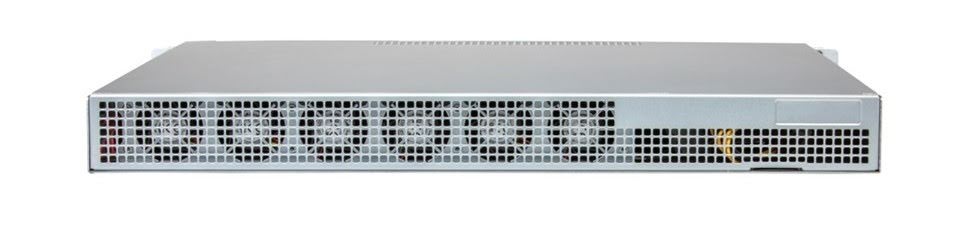
Supermicro’s 1U SYS-112D-42C-FN8P and 2U SYS-212D-72C-FN8P systems turn these silicon advantages into deployable reality. Outdoor-rated and air-cooled compact designs with redundant Titanium power supplies fit perfectly into constrained edge sites. The integrated E830 NIC delivers nanosecond-accurate Precision Time Protocol (PTP) and SyncE synchronization essential for vRAN and ORAN deployments. The 1U system is already an official O-RAN Alliance hardware reference design for outdoor macrocells.
SUSE completes the solution with SUSE Telco Cloud – a hardened, modular, cloud-native software stack specifically designed to meet the strict demands of the telecommunications industry, enabling operators to host both VNFs and CNFs on the same platform. Built on SUSE Linux Micro, RKE2, and SUSE Rancher Prime, the platform provides a secure, carrier-grade foundation for 5G, fixed access, OSS/BSS, and edge infrastructure. It’s built entirely on open source and has been rigorously validated to deliver reliable performance at scale. Its AI-ready, disaggregated architecture supports zero-touch automation and the flexibility to integrate best-of-breed network functions efficiently and sustainably.

SUSE Telco Cloud offers automated lifecycle management for infrastructure components, support for multi-cloud and edge deployments with consistent operations, and enhanced observability through integrated monitoring tools. Furthermore, it ensures security at scale, from OS hardening to container scanning, while its foundation in open standards and ecosystem support effectively prevents vendor lock-in. A key differentiator is SUSE’s robust edge computing capabilities, as SUSE Telco Cloud is optimized for constrained environments, enabling telcos to deploy CNFs and VNFs in remote or decentralized locations with minimal overhead – a flexibility essential for new 5G-powered services like smart city infrastructure and industrial IoT. The solution also facilitates zero-touch provisioning and seamless orchestration at the edge, which dramatically reduces operational complexity and deployment times. Ultimately, with its modular, open architecture, SUSE Telco Cloud allows operators to unlock efficiencies in the core, deploy innovative services at the edge, and adapt rapidly to future market demands.
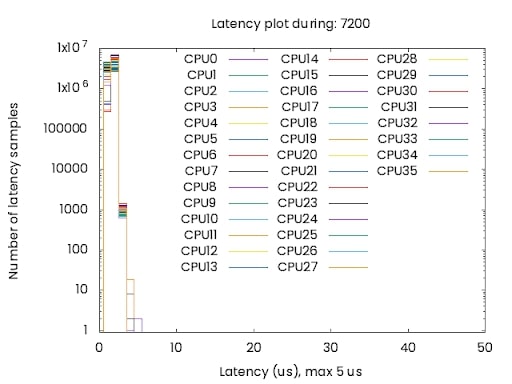
By uniting Intel’s fully-integrated vRAN Boost and AI acceleration, Supermicro’s rugged edge-system engineering and global supply-chain excellence, and SUSE’s zero-touch, GitOps-driven telco cloud stack, this solution delivers a true single-box, CPU-only telco cloud node that simultaneously replaces the legacy BBU, external L1 accelerator (FPGA/in-line card), SmartNIC, timing card, and discrete AI inference appliances. Under a 95% CPU load on the isolated cores, the platform successfully achieved a measure of latency of sub 5µs. This achievement demonstrates that the consolidated, CPU-only architecture powered by Intel® Xeon® 6 SoC and orchestrated by SUSE Telco Cloud can deliver the guaranteed, deterministic, low-latency performance required for the most demanding 5G and ORAN use cases.
A single SYS-112D-42C-FN8P powered by Intel® Xeon® 6 SoC and running SUSE Telco Cloud now consolidates everything, previously spread across several separate devices, into one compact, outdoor-rated 1U system.
Operators realize dramatic gains:
Supply-chain risk is minimized through Supermicro’s Tier-1 scale and regional manufacturing, while SUSE Telco Cloud enables fully automated, reproducible deployments across tens of thousands of sites with zero touch provisioning. The entire platform is open, disaggregated, and future-proof, supporting everything from today’s RAN deployments to tomorrow’s AI-native 6G edge networks.
Conclusion and Next Steps
The combination of SUSE Telco Cloud, Intel® Xeon® 6 SoC, and Supermicro telco-optimized servers delivers a future-proof, CPU-only telco-optimized cloud platform that provides uncompromised performance, radical simplicity, genuine sustainability, and investment protection at scale while dramatically reducing power, physical space, and TCO. Together, we enable operators to stop compromising and start transforming.
To move forward with transforming your network, please contact your SUSE, Intel, and Supermicro account teams to arrange a joint solution workshop and receive expert sizing assistance tailored to your specific deployment needs. For technical deep dives, you can access the SUSE Telco Cloud deployment documentation, review Intel’s resources on the Xeon® 6 Processors Networking and Edge, the Platform and Performance Advantages to Accelerate vRAN Deployments, and the Leadership AI and Networking Solutions with Xeon 6 Processors, and examine the Supermicro specifications for the SYS-112D-42C-FN8P and SYS-212D-72C-FN8P systems.
Guest authors:
 Michael Holzerland, EMEA Telco Lead at Supermicro, bringing more than 30 years of IT experience and over 20 years of expertise in the telecommunications industry. He works closely with leading European telecom operators and partners on AI infrastructure, cloud platforms, and open telco architectures. His focus includes AI-native telco clouds, ORAN, edge and core network modernization, and large-scale GPU and CPU deployments, with a strong emphasis on open ecosystems and sovereign cloud initiatives across Europe.
 Niall Power, Solutions Architect and Intel FlexRAN Software PLM. Niall has worked on FlexRAN for over 15 years driving innovation across the stack from 4G to 5G and now AI RAN. Niall works collaboratively with the FlexRAN ecosystem, enabling software centric intelligent Cloud RAN solutions on Intel products including the latest Xeon 6 SoC. Focusing on HW and SW integrations, Niall is a contributor and editor in the O-RAN Cloudification and Orchestration Working Group.
Related Articles
Jun 03rd, 2025
Understanding the Evolving Landscape of Linux Kernel CVEs
Jul 29th, 2025
The Challenge of Persistent Data on Kubernetes