Taming the AI Beast: How to Build a Secure and Scalable AI Platform with SUSE and ClearML
Let’s be real: Enterprises are currently heavily investing in AI infrastructure to support everything from process automation to custom model development.
The AI Production Trap
But here is the catch—moving from isolated, cool AI experiments to reliable, repeatable production deployments is a massive hurdle. Without a centralized management layer, expensive compute resources like GPUs are often fragmented across teams and severely underutilized. Add in fragmented tools, inconsistent access controls, and operational complexity, and you are suddenly looking at a lot of lost ROI.
Introducing the Enterprise AI Lifecycle TRD
That is exactly why we are so excited to introduce our latest Technical Reference Documentation (TRD): Enterprise AI Lifecycle with SUSE AI and ClearML.
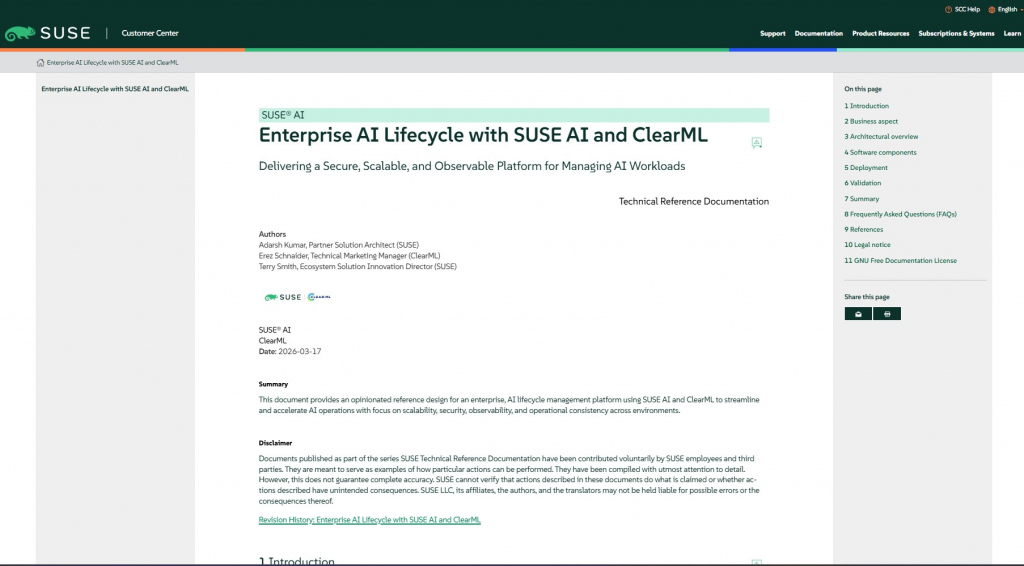
This guide is not about teaching data science methodologies; instead, it is written specifically for platform engineers, infrastructure architects, and MLOps teams who actually have to run this stuff. It provides a validated, opinionated, yet flexible reference design that pairs SUSE AI with ClearML to create a secure, Kubernetes-native foundation for your AI workloads.
Delivering Real Business Value
So, what makes this combination so powerful for delivering real business value? Here are a few highlights:
- No More Wasted GPUs: It solves the hardware underutilization problem by using ClearML to orchestrate workloads, optimize GPU usage dynamically, and enforce policy-driven resource governance.
- Controlled Multi-Tenancy: You can operate your shared compute as a controlled, multi-tenant platform, keeping different teams isolated but efficient.
- Security from the Ground Up: The architecture is built with enterprise-grade security and governance in mind, making it perfectly suited even for highly regulated sovereign AI initiatives. It leverages SUSE Security for vulnerability scanning and runtime protection, and SUSE Private Registry for secure container image distribution.
- Scale Anywhere: You get the ultimate flexibility to scale your AI infrastructure across on-premises, hybrid, and multi-cloud environments. This agility is powered by SUSE Rancher Prime for multi-cluster management and SUSE Kubernetes Engine (RKE2) for secure orchestration, all running on the rock-solid SUSE Linux Enterprise Server operating system.
Proven in Real-World Scenarios
Inside the TRD, we also break down real-world customer scenarios where this setup truly shines. For example, you will see how the architecture enables strict isolation and centralized GPU visibility for secure, air-gapped defense environments. And we cover how financial services organizations can automate cloud bursting for managing massive datasets, and how global research teams can reliably scale the fine-tuning of customized LLMs.
Ready to Standardize Your ML Workflows?
If you are ready to standardize your machine learning workflows and give your AI builders the tools they need—without spinning up a completely separate, fragile MLOps stack—this document is for you. Dive into the architectural diagrams, software components, and step-by-step deployment considerations by reading the full Enterprise AI Lifecycle with SUSE AI and ClearML guide today.
Related Articles
Apr 17th, 2025
Agentic AI: Balancing Risk With Innovation
Jun 16th, 2024
Meet the docs at SUSECON 2024