Broadcom VMware told them to sell, instead FIS Group built something bigger.
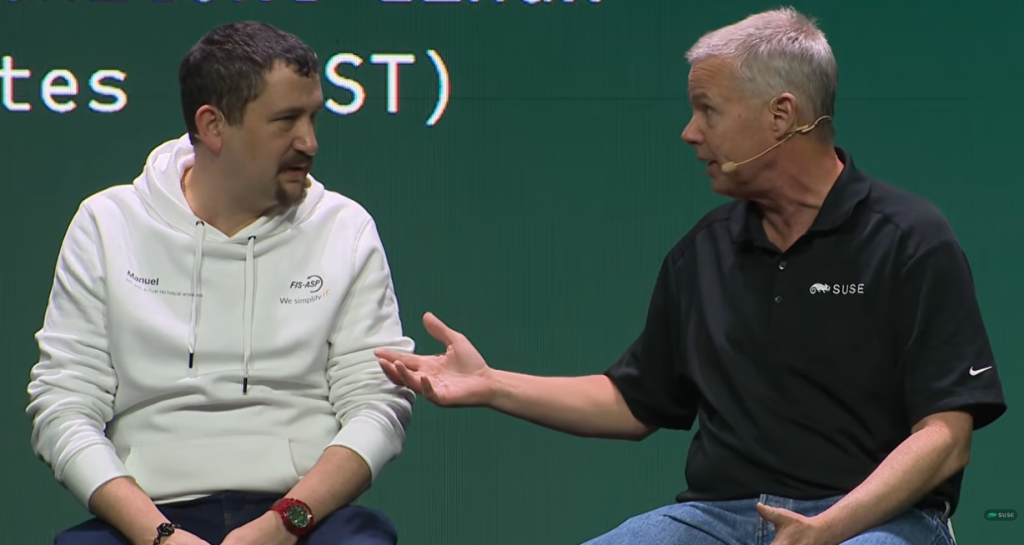
At SUSECON 2026, Manuel Sammeth walked onto the keynote stage and said something that made half the room gasp.
“We have been told to sell our business to a bigger partner. That came directly from Broadcom. They told us, ‘Oh, sorry. You’re not a partner anymore. Sell your business to a bigger company.’”
— Manuel Sammeth, Managing Director, FIS-ASP
Even Peter Smails, SUSE’s SVP and GM of Cloud Native, didn’t have a response ready. “I did not know that,” he said. “That was not the answer I was expecting.” The comment was unscripted. The panel was live. And Manuel was not done.
The audience yelled that it was a hostage situation. Manuel laughed and jokingly corrected him.
“That’s not even a hostage situation because they killed us.”
The room laughed with him, but the point landed. Manuel was finding humor in something that wasn’t funny when it happened and an experience that may be shared by others.
Here is what you need to know about the company Broadcom told to sell.
FIS-ASP runs 1,500 SAP systems from data centers in Germany. They have 950+ employees across the FIS Group. They hold SAP Gold Partner status. They have been technology leaders for 25 years.
They are not a company that needs to be told what to do. And they did not sell.
Manuel was not just speaking for FIS-ASP on that stage. He was speaking for every partner who built a business on a platform that changed the rules overnight.
They didn’t sell, the kept building
FIS-ASP invested in open source infrastructure. They went deep into SUSE Virtualization and SUSE Rancher Prime. The result was not a lateral move. It was an expansion.
“We are deep into virtualization because VMware is not our friend anymore. So we are heavily investing in the SUSE Virtualization platform right now, which opens a new market for us because we only operated from our own data centers in the past. Now we’re operating in the data centers of our customers, in hybrid clouds, and everywhere else.” — Manuel Sammeth
That last part matters. FIS-ASP had always operated from their own facilities. Three redundant data centers in Bavaria. German soil. German jurisdiction. That sovereign foundation gave them something most providers can’t offer. Now, with SUSE Virtualization and SUSE Rancher Prime, they can extend that same standard of sovereignty and control into their customers’ environments without compromise.
“SUSE Rancher Prime enabled us to start a new business area where we can manage services for our customers from anywhere.” — Manuel Sammeth
This is not a company that escaped a bad situation. This is a company that used disruption to grow into new markets.
FIS were leaders in Digital Sovereignty before it was a buzzword
FIS-ASP was ahead of the curve on digital sovereignty before the word became a conference talking point. Their data centers sit in Germany. Their operations follow German and EU compliance frameworks. When European enterprises started asking harder questions about where their data lives and who can access it, FIS-ASP already had the answer. Manuel said his company is “further on the sovereignty path than many others”, and now enterprises around the world are looking to them as an example to solve their sovereignty issues.
The shift to open source infrastructure made that advantage portable. With SUSE Rancher Prime providing a consistent Kubernetes management layer and SUSE Virtualization replacing proprietary hypervisors, FIS-ASP can now deliver sovereign managed services wherever their customers need them. Same tooling. Same security posture. Same data governance. Whether the workload runs in Grafenrheinfeld or a customer’s hybrid cloud.
Open source is their in their DNA
It would be easy to frame this as a story about leaving one vendor for another. Manuel made clear it is bigger than that.
“Openness means to be curious. To have the urge to explore and build new things. To imagine, to build, to enable. I grew up in a small town which has less people in it than here in the room, but I was able to build things because of open source. And that’s the way it should work.” — Manuel Sammeth
FIS-ASP is now investing in AI. They are developing medical solutions that help doctors and patients, built on SUSE Rancher. Their developers are no longer confined to the SAP universe. They build with APIs and open standards and can serve any market.
This is what happens when a company with deep technical talent meets infrastructure that doesn’t put walls around them.
An enterprise any provider would be proud to serve
Manuel also said something during the panel that stuck. He was talking about what he expects from SUSE, and from any vendor.
“I really enjoy that I can take, for example, Rancher, try it out at home for free, open source. And if the choice has been made, I can buy the product. I can buy the responsibility and the reliability of a real enterprise product. And that’s what I like. I hope it stays like it is, that we have people who we can talk to in the management, to the technicians. I think that’s your [SUSE’s] greatest responsibility against your customers. And I really enjoy working with you because of that.” — Manuel Sammeth
That is the standard. Not just open code, but open relationships. Access to engineers. Access to leadership. The freedom to evaluate before you commit. SUSE does not take it for granted.
Watch the full conversation
Manuel’s comments were part of a SUSECON 2026 keynote panel that also featured Francisco from ITQ and Andy from MTU Aero Engines. The full discussion on openness, vendor responsibility, and the future of cloud native infrastructure is worth your time.
Watch the full panel discussion: SUSECON 2026 Cloud Native Keynote
Reach out to your friendly SUSE account team today
If you’re evaluating SUSE Virtualization as a VMware alternative, you’re not just getting a modern, Kubernetes-native virtualization platform, you get a trusted partner and regain control.
→ Become free from lock in today, If your organization is navigating a similar transition, we’d like to hear from you. Contact your SUSE account team.
Additional Resources
→ Ready to try it yourself? Follow our step-by-step SUSE Virtualization Proof of Concept Guide to set up your environment
→ See how to move off VMware, Download the Coriolis and SUSE Virtualization datasheet to plan your migration.
¹ Lower costs by leaving proprietary vendors, and cover the migration with an IDC study reporting 258% ROI or $3.4M a year with SUSE Virtualization and SUSE Rancher Prime.
Related Articles