AI-Ready Telco Cloud: How to Ensure Your 5G Network Can Handle AI
Key takeaways
- Horizontal telco cloud enables AI integration: Vendor silos fragment data and block AI models from operating across network domains, preventing autonomous operations.
- Four requirements ensure carrier-grade infrastructure: Operators must verify sovereignty, security, support and standardization when selecting a telco cloud platform.
- Telco clouds require specialized capabilities: Unlike IT clouds, telco clouds must support real-time execution, precision timing, hardware accelerators and legacy telecommunications protocols.
- Standardization cuts costs and accelerates innovation: Horizontal telco clouds reduce onboarding times, eliminate duplication and enable common automation across vendors.
- Open source foundations future-proof investments: Vendor-agnostic platforms like SUSE Telco Cloud support 5G today while maintaining flexibility for 6G and AI-driven capabilities tomorrow.
One of the biggest struggles for communications service providers today is managing a patchwork of isolated cloud environments for their CNF vendors, each with its own infrastructure stack, automation tools and operational requirements.
While individual network functions may work perfectly within their vendor-supplied cloud silos, the network as a whole is increasingly difficult to optimize, automate or evolve.
And as AI emerges as the next frontier for network innovation, these silos are turning into a critical obstacle: AI models cannot work across separate vendor domains, which makes intelligent, autonomous operations nearly impossible to achieve.
Industry analyst Caroline Chappell, founder of CC Squared with over 35 years of experience in telecommunications, argues there’s a better path forward—one that positions telcos for 5G success, 6G readiness and effective AI integration.
Why horizontal telco cloud is the future
Horizontal telco cloud is a unified, vendor-agnostic platform capable of running multiple CNFs from different vendors on a single, standardized infrastructure, which makes it a future-proof foundation for cloud native networks.
In our recent white paper, “Defining the Telco Cloud for 5G Networks: Key Requirements for a Successful Implementation,” industry expert Caroline Chappell explains that horizontal telco clouds deliver distinct advantages that siloed approaches simply cannot match.
Core advantages of horizontal telco cloud
AI alignment: A horizontal telco cloud creates the unified platform necessary for running CNFs and AI workloads together. As Chappell notes, “The most compelling argument for a horizontal telco cloud is that without it, operators will not be able to leverage AI effectively across the end-to-end fabrics that their networks must become.” AI models are themselves cloud native, and co-locating them with CNFs optimizes network performance, resilience, agility and monetization potential.
Standardization: Horizontal telco clouds align with industry-wide initiatives like Project Sylva, which aims to create common, open source telco cloud reference architectures. This standardization significantly reduces CNF onboarding costs and times while accelerating time-to-market for new services.
Orange, one of the world’s leading telecommunications operators, has leveraged this approach to streamline service delivery across multiple countries, demonstrating how horizontal telco cloud architecture cuts integration times for new network functions.
Total cost of ownership (TCO) reduction: By standardizing hardware and enabling common automation across multiple CNFs, horizontal telco clouds eliminate the duplication inherent in siloed approaches. Operators benefit from efficient resource utilization and shared operational automation, which are cost savings that compound quickly at enterprise scale.
Understanding telco cloud requirements
While horizontal telco clouds use the same foundational components as IT clouds, such as Linux operating systems, Kubernetes orchestration and security tools, they require different capabilities to support CNFs in their processing of network traffic.
Here are a couple of critical technical differences:
First, since a telco cloud is a complex environment which requires different capabilities than an IT cloud to support CNFs, some CNFs must execute in real time to fulfill their function in the distributed system. The telco cloud needs to support timing protocols to synchronize the network of CNFs running on it, accommodate diverse workloads through appropriate drivers and accelerators and support legacy telecoms protocols.
Also, the scaling requirements differ significantly. While other industries need to distribute cloud across thousands of sites, telecommunications networks are a critical infrastructure. This means the telco cloud must meet strict security and operational service-level agreements at scale, subject to higher regulatory scrutiny than distributed cloud infrastructure in many other sectors.
How to select a horizontal telco cloud platform
Chappell outlines four essential requirements that operators should verify when selecting a horizontal telco cloud platform. These requirements ensure the infrastructure is carrier-grade, compliant and positioned for long-term success.
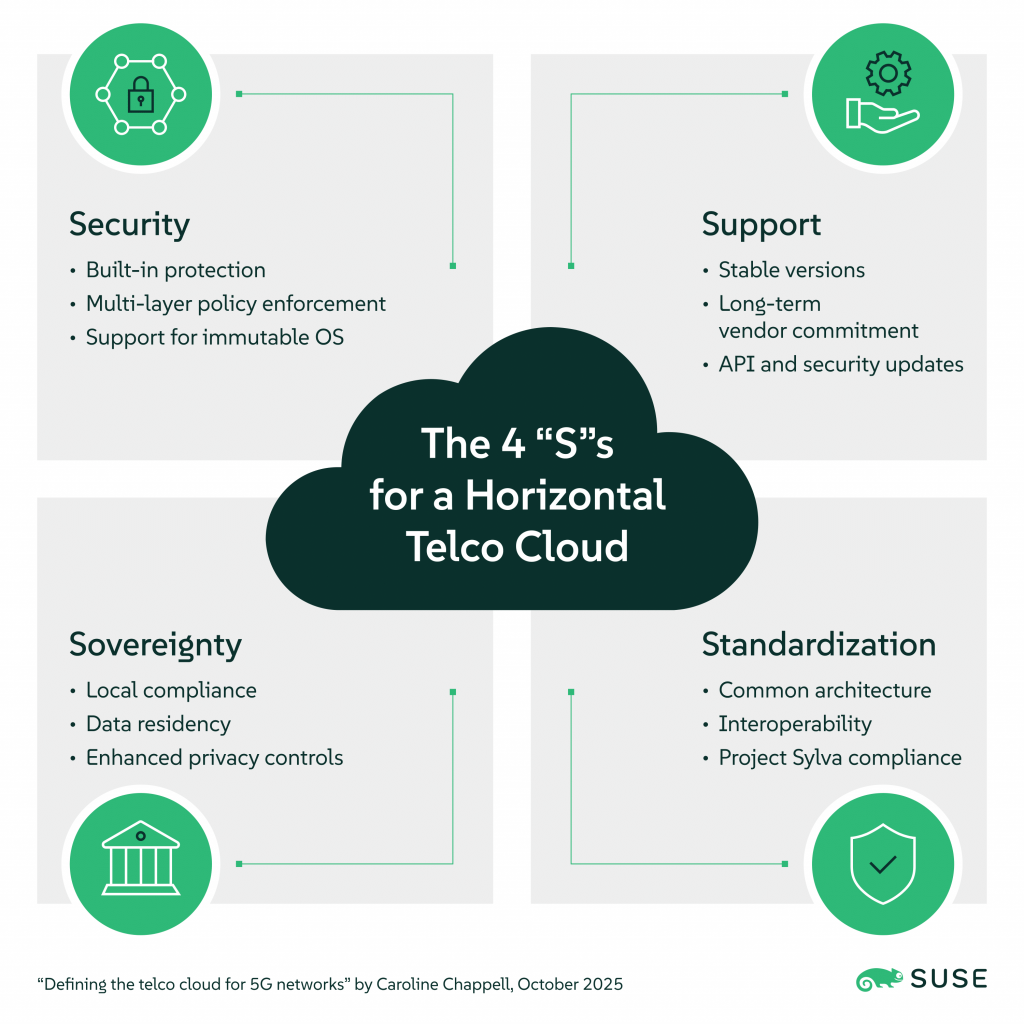
Sovereignty: As providers of critical national infrastructure, telcos must ensure their cloud native networks comply with local laws and regulations regarding data residency and operations. The telco cloud should demonstrate sovereign freedom from control by external parties and incorporate enhanced security and privacy controls that enable regulatory compliance.
Security: Security must be built into every layer and component of the telco cloud by design. Operators should expect comprehensive security features, including support for immutable operating systems, tools that enforce security policies across all components and robust auditing and reporting capabilities. Security is foundational for networks that process sensitive customer data and support mission-critical services.
Support: Unlike IT clouds that deploy continuous feature updates, telco clouds need to operate in a steady state over extended periods to give stability and predictability to network functions. CNFs have long acceptance testing cycles, and migrating telco cloud environments to new versions is expensive. Operators need vendors who provide long-term support for specific versions while keeping APIs and security patches current. Vendors should also synchronize upgrade cadences with ecosystem partners and provide pre-testing and validation tools.
Standardization: According to Chappell, “proprietary and fragmented systems create unsustainable integration costs for network function vendors and prolonged acceptance testing times for operators.” Operators should participate in initiatives that drive greater homogeneity of telco cloud infrastructure, maximizing their platform’s longevity and ability to evolve with the industry.
Modernizing with confidence
The transformation of telecommunications networks into software-based, AI-driven platforms based on cloud technologies is inevitable, given the trajectory of 5G networks and 3GPP plans for 6G. SUSE Telco Cloud addresses these requirements by delivering a secure, carrier-grade foundation built entirely on open source technologies.
SUSE Telco Cloud supports the Sylva framework and offers robust infrastructure for hosting critical network functions from core to edge. Its AI-ready architecture allows operators to deploy and operate CNFs alongside AI workloads, with zero-touch provisioning and lifecycle automation that keeps systems current without compromising availability. The platform’s lightweight, security-hardened components make it highly suitable for resource-constrained environments like network edge locations.
Orange‘s success demonstrates these principles in action. By adopting an open telco cloud architecture with SUSE, Orange streamlined service delivery across multiple countries, with automation and interoperability cutting integration times for new network functions. Today, their solution supports millions of daily connections while maintaining carrier-grade reliability across the entire footprint.
The path to AI-ready infrastructure
As Chappell concludes, operators who understand the specific features needed in a horizontal telco cloud can select and deploy solutions that allow them to leverage AI effectively across their networks.
The choice is clear. Fragmented, siloed cloud environments may seem simpler in the short term, but they create technical debt that grows more complex and costly over time. A horizontal telco cloud built on open standards, with proper attention to sovereignty, security, support and standardization, positions operators to create new revenue streams, reduce costs and lead with innovative 5G and AI-driven services.
Learn more about the technical requirements and strategic considerations for implementing horizontal telco cloud in our new white paper by industry expert Caroline Chappell, “Defining the Telco Cloud for 5G Networks: Key Requirements for a Successful Implementation.”
Discover how SUSE Telco Cloud can offer you the carrier-grade foundation needed for 5G success and AI integration.
Related Articles
Jun 03rd, 2025
Understanding the Evolving Landscape of Linux Kernel CVEs