A Unified Approach to Virtualization
Managing enterprise IT often feels like keeping one foot in the past and the other in the future. On one side, you have legacy virtual machine infrastructure that your operations team knows inside out; on the other, cloud-native containerized stacks driving rapid application development. Running these environments separately usually means maintaining duplicate hardware investments and navigating siloed operations.
To pull these parallel worlds together, SUSE Virtualization unifies both virtual machines and containers on a single, Kubernetes-native platform. When combined with Portworx Enterprise by Everpure and an Everpure FlashArray, you gain a highly resilient framework capable of delivering high availability, multi-cluster support, and robust data services for your stateful workloads.
SUSE has released two interconnected technical guides to help platform engineers move from basic installation to production-grade bare metal architecture.
From Blueprint to Deployment
If you are looking for a practical, step-by-step walkthrough to get this architecture off the ground, the Getting Started Guide: Modern Virtualization with SUSE and Everpure is your starting point. It avoids abstract theories and focuses directly on the mechanics of building a functional integration.
The guide breaks the deployment process down into clear, sequential milestones:
- Preparing the Cluster: Administrators optimize the SUSE Virtualization cluster with host-level multipath configuration and create a dedicated Kubernetes secret to safely store Everpure FlashArray credentials.
- Generating the Tailored Installation Specs: Using the Portworx Central Web portal, you construct a tailored installation specification for the underlying Rancher Kubernetes Engine (RKE) environment.
- Deploying the Components: You execute the generated installation specs to deploy the Portworx Operator, which manages the Portworx Enterprise installation and configuration.
- Defining the VM Storage: You create a customized default StorageClass for persistent VM disk volumes.
- Validating the Environment: You wrap up with practical operational validation by launching a virtual machine in SUSE Virtualization and ensuring its primary root disk binds cleanly to the Everpure FlashArray via the Portworx CSI driver.
Bare Metal Architecture Design
When your initial setup is validated, transitioning to a production environment demands a deeper look at physical constraints. The accompanying Reference Configuration: SUSE Virtualization with Portworx Enterprise by Everpure on Bare Metal addresses the distinct structural design requirements of running this integration directly on bare metal physical infrastructure.
Deploying on bare metal strips away unnecessary abstraction layers to unlock raw hardware performance, but it shifts the responsibility for high availability squarely onto your initial design choices. The reference documentation outlines critical blueprints to keep your bare metal architecture optimized:
- Production Node Scaling: While a minimum of three nodes establishes basic quorum, a six-node cluster is recommended for production environments to minimize capacity loss and maintain I/O stability during a single node outage.
- Network Path Segregation: The guide warns against using default single interface setups for production, advising engineers to explicitly isolate management traffic from high-throughput data replication networks to avoid severe performance congestion.
- Predictable Storage Pools: Storage pools must be composed of drives with identical capacities and technical specifications to prevent uneven performance characteristics across your storage replicas.
- Dedicated Journal Provisioning: To ensure snappy metadata write response times, the reference architecture recommends allocating a dedicated, high-performance 3 GB NVMe or SSD volume specifically as a journal device.
Summary
Combining SUSE Virtualization and Portworx Enterprise by Everpure on bare metal eliminates the artificial barriers between your legacy virtual machines and modern containerized workloads. By standardizing on a singular cloud-native operating model, you can streamline daily maintenance, eliminate redundant hardware silos, and protect your data assets with enterprise-grade performance.
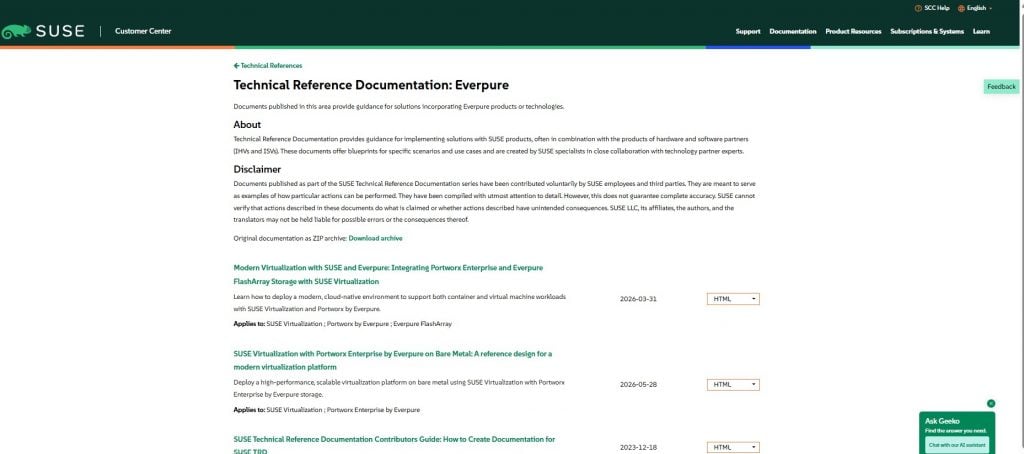
Ready to dive into the technical details? You can find both the step-by-step Getting Started Guide and the detailed Reference Configuration by heading over to the SUSE Documentation Portal, selecting the dedicated Technical Reference Documentation tab, and clicking the Everpure section.
A huge shout-out and kudos for delivering these incredibly valuable guides to Gopala Krishnan (Partner Solution Architect, SUSE), Suresh S (Partner Solution Architect, SUSE), and Terry Smith (Partner Solution Innovation Director, SUSE) , as well as Bhumitra Nager (Member of Technical Staff, Everpure) and James McShane (Consulting Cloud Native Architect, Everpure), and for sharing their combined structural and cloud-native expertise!
Related Articles
Nov 06th, 2024
Configure SAP services to log outsite of journald
Apr 03rd, 2025
Understanding Kubernetes Security Basics And Best Practices
May 05th, 2026
Virtualization changed. Download the Gartner® Market Guide.