
Workload Repatriation Is a Resilience Strategy, Not an IT Project

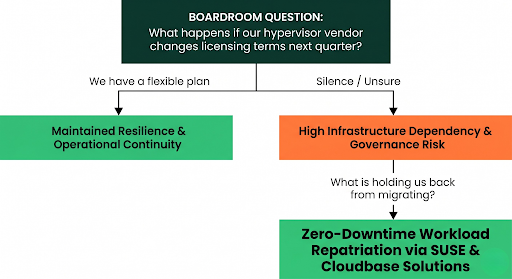
Your board asks a simple question, “What happens to our operations if our hypervisor vendor changes the licensing terms next quarter?”
The room goes quiet. Nobody has a good answer.
That silence is your answer. It’s a question more boards should be asking right now. Your hypervisor provider has a stronghold over the choices you have.
Your hypervisor choice is a governance decision
Executive teams stuck in the past still treat infrastructure decisions as purely operational. Which hypervisor, which cloud, which vendor. These feel like IT choices. In reality, they are governance decisions with direct impact on your company’s ability to respond to change.
When a single vendor like Broadcom VMWare controls your foundational virtualization layer, they control more than just technology. They control your cost trajectory, your upgrade timeline, and your options when regulations shift. If that vendor operates under a different jurisdiction, you risk influence where your data sits and who has access.
I hear this everyday from CIOs and CTOs across the globe. Leaders in Europe, the Middle East, and Asia-Pacific have real urgency. The pattern is always the same.
When a proprietary vendor raises prices or changes licensing terms, organizations suddenly discover how deep the dependency goes. It reaches into budgets, roadmaps, and compliance postures. And by the time that discovery happens, the room for manoeuvre is already small.
This is why I warn leaders that infrastructure dependency is a resilience risk. It belongs on the board agenda, right next to cybersecurity and supply chain continuity.
Workload repatriation puts sovereignty into practice
A word that gets used a lot in our industry is sovereignty. It can feel abstract. But at its core, it means something very concrete. Having the ability to freely decide. Choosing where your workloads run, who manages them, and under which jurisdiction your data resides.
Workload repatriation is what sovereignty looks like in practice. It means bringing VMs back from public clouds into data centers that you control. It means leaving proprietary hypervisors to open source alternatives where you own the technology decisions. And it means ensuring your data stays within your country’s boundaries when regulations like DORA, the Cyber Resilience Act, or national security frameworks require it.
For companies running on proprietary virtualization stacks, this step is significant. You reduce dependency on a single external party. You gain the freedom to choose where your workloads run and how your infrastructure evolves. And you build an IT foundation where no vendor can force changes onto your roadmap without your consent.
Open source is the natural foundation for this. When your virtualization platform is built on open standards and backed by community development, you are never locked in. You always have options. That is what resilience looks like at the infrastructure level.
The migration barrier that kept companies locked in is gone
For years, the biggest reason companies stayed with their existing hypervisor was migration risk. Moving hundreds of production VMs while keeping applications online. Ensuring SAP environments remain stable and certified. With average manual migrations taking up to 48 months per this Gartner research.These are legitimate concerns that keep many organizations locked into contracts that cause damage.
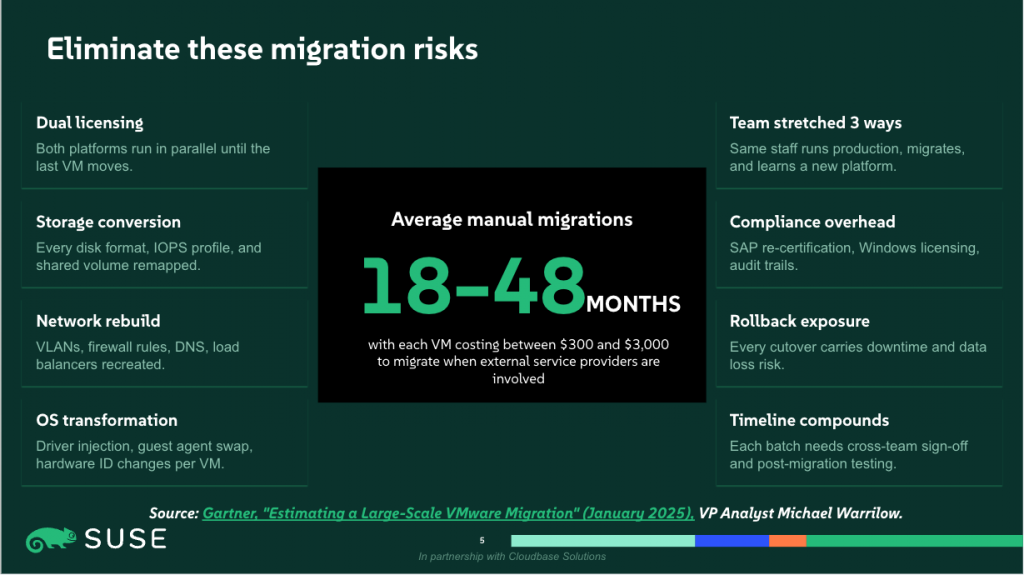
That barrier has now been removed.
SUSE® has partnered with Cloudbase Solutions to integrate the Coriolis® migration platform into SUSE Virtualization. Organizations can now migrate virtual machines from VMware and public clouds with zero service interruptions. Applications keep running while data is replicated in the background. No weekend maintenance windows. No service outages.
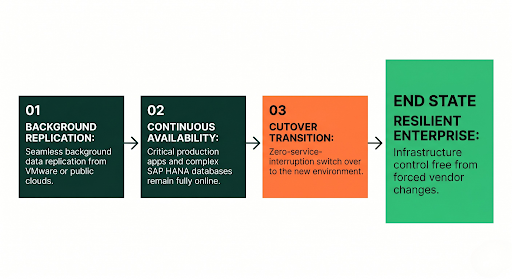
Three things make this particularly relevant for executive decision-makers:
- Zero-downtime migration removes the operational risk that made leaving proprietary hypervisors feel too dangerous
- Cloud repatriation support covers migrations from AWS, Azure, and Google Cloud back to your own infrastructure
- SAP environments have a verified migration path to SUSE’s KVM-based certified hypervisor, including SAP HANA databases
An IDC study reports 258% ROI ¹ for organizations running SUSE Virtualization and SUSE Rancher Prime. When you combine cost reduction with reduced vendor dependency and full operational control, the business case is clear.
As Frank Feldmann, SUSE Chief Strategy Officer, put it, “VMware is a hostage situation”. Customers want to escape proprietary ecosystems that dictate their budget and their roadmap. SUSE and Coriolis by Cloudbase makes that possible without the migration risk that used to hold them back.
What about your situation?
I challenge any executive reading this, do you know what happens to your operations if your primary infrastructure vendor changes the rules tomorrow?
If the answer is “I’m not sure,” that is exactly where the conversation about resilience needs to start. And it is a conversation worth having before the next licensing change forces it.
I work with organizations across the world on reducing resilience risk through sovereignty-driven IT strategies. If you want to explore how workload repatriation fits your company’s situation, I am happy to have that conversation.
Connect with me on LinkedIn.
→ Start your migration with Coriolis today and contact your SUSE account team.
→ See how to move off VMware, Download the Coriolis and SUSE Virtualization datasheet to plan your migration.
Additional Resources
→ Ready to try it yourself? Follow our step-by-step SUSE Virtualization Proof of Concept Guide to set up your environment
Coriolis is a registered trademark of Cloudbase Solutions. SUSE Virtualization is built on the open-source Harvester project and uses KubeVirt for VM management.
¹ Lower costs by leaving proprietary vendors, and cover the migration with an IDC study reporting 258% ROI or $3.4M a year with SUSE Virtualization and SUSE Rancher Prime.
Related Articles
May 18th, 2026
An Open Letter from Europe’s Open Source Industry
Nov 13th, 2024
Adding own Documents to your Local AI Using RAG
